Making Corn Mash and Bait for Hogs!
© 2008-2011
Albert A Rasch and
The Rasch Outdoor Chronicles™
$g&m f9bd 45kd q!?5.
"You don’t know discomfort until you have sat upon a fire ant nest."
My favorite game animal has to be the Wild Hog. Not only is he wide spread, but the limits are usually pretty liberal. Learning their behavior and habits is not too difficult, and gaining permission to hunt them on private property isn’t usually a problem either. In many cases they are right next door and on occasion they may very well be rooting up your front yard.
Hunting wild hog is a wonderful introduction to big game hunting in general. For those of us who desire a greater challenge, hogs can be hunted with dogs, bows, spears, shotguns and handguns. I’ve hunted razorbacks on foot with dogs and a handgun, (see
Hogs and Dogs), and I have pursued them on horseback with a shotgun, (Soon to be posted: Horseback Hunting. If you are wondering what the proper calibers for wild pigs are, at least in my opinion, go to Boar Guns and Calibers
Parts I and
Part II, where I discuss hog and wild boar rifle cartridge selections.
Their keen sense of smell allows them to be easily baited and therefore make themselves a great first choice for an aspiring hunter. The best thing about them is that if you have a place where you know hogs are, then baiting them in is not difficult at all. They are already there, all you have to do is give them a reason to come here, something like a hog attractant.
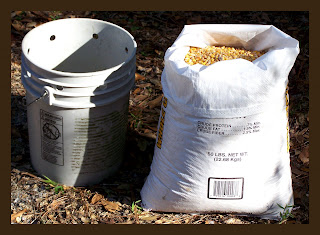
 If you want to attract wild pigs, you’ll need a five gallon bucket and the cover. You’ll need the bucket to hold the corn that you are going to ferment, in order to attract the pigs. You can buy them new at any of the big box home improvement stores, or scrounge them up from a restaurant or painters. All they need is a quick clean-up, nothing more than a good hosing out.
Pull out your trusty drill, and a three quarter inch spade bit. Drill a series of evenly spaced holes around the side of the bucket between the rim and the section that the handle is secured to. Eight to twelve holes are sufficient. The plastic will get stuck to the tip of the drill bit. Remove it before drilling the next hole.
Now the fun part!  Stop by the feed store and get yourself a fifty pound sack of whole corn. Wink at the girl at the register if she looks at you a little funny. Now stop by the supermarket and get five pounds of sugar. Somewhere around the baking section you’ll find the yeast. Buy a strip or two. Pick up a six pack of the cheapest beer. (Kids, you really don’t need beer for the mix, but it does help get the mash fermenting, so ask Mom or Dad for help on this.) The girl probably won’t look at you funny there, but wink at her too just for good measure. If for some strange and unfathomable reason you can’t find a feed store, head down to the same home improvement store you got the bucket at, go to the bird seed aisle, and get a bag of cracked corn. You can even use cheap birdseed if you can’t find the corn. Sunflower seeds though, are no good; too much oil.
 Back at home, fill the bucket about two thirds of the way with corn (or bird seed). Throw in a couple of cups of sugar. Now add enough warm water to cover the corn; stir with a stick for a couple of minutes. Now add a packet of yeast, stir well, and pop a can of beer and stir that in.
Keep your mash someplace relatively warm. By the next day the corn will have sucked up most of the water, so add more water until the corn is covered again. Within a day or two the sugar, yeast, and corn will start to ferment and a sweet smell will start to waft up from the bucket. Ahhh, the sweet smell of wild hog attractant.
 Setting up is easy. Find a large tree with a good wide canopy. Throw a rope over a large limb. It has to be a relatively inflexible limb that won’t move when loaded down with five gallons of fermented pig feed. Tie the rope to the handle where the bottom of the bucket is about six to eight inches off the ground. Throw in another cup of sugar, and enough corn and water to fill the bucket. This will keep it fermenting longer. Take a couple of handfuls of corn and throw them around the bucket.
If you have to rucksack this to a remote hunting area, you can carry everything dry and pre-mixed in the bucket, and lug the water separately. If there’s a pond, stream, or creek, use that and save yourself the trouble of carrying water. You will have to wait a little longer for the corn to start fermenting, but your back will thank you.
When the hogs get wind of the fermenting corn, they’ll follow their noses right to your set-up. I have had them show up in as little as four hours and sometimes it has taken a couple of weeks. If you don’t see any in five or six days, check if your mash is still fermenting; if it isn’t, dump a third of the corn out around your set-up, add a couple of more cups of sugar, and top it off with more corn and water. If it is cold, try and position the bucket where it will get some sun; paint it black if need be. Yeasts need warmth to do their job of converting starches to sugars and sugars to long chain carbohydrates.

Wild hogs are really quite smart and more than capable to figure out how to get more corn out of the bucket. They will use their snouts and tip the bucket on its side; due to the rope the bucket will tip off their snout and only a small amount of corn will drop out and onto the floor. But that’s enough to keep them very interested.
I recommend doing a little scouting in the early afternoon to check if the pigs are using your set up. When they get there, you probably don’t want to shoot right at your feeder. Somewhat unsporting there dear chap. But wild hogs are very accommodating and will almost always leave you a very clear trail from their bedding areas. It is important that you don’t walk within six feet of their track. They’ve got great noses you know! Try to parallel it until you find a convenient spot with a good shooting lane. If you want to stack the deck in your favor toss a few handfuls of corn in a six foot circle. The pigs will stop there for a few moments to gobble up the goodies you left there for them to eat. If you are taking out someone new to hunting, this is a good way to stop a pig in order to give the neophyte enough time to make a good shot.
Other animals might make use of your feeder. I have seen raccoons and ‘possum mooch corn from the feeder. The most amusing visitor I have had the pleasure to observe was a Blue Jay that knew there was corn to be had, if he could only figure out how to get it. He went ‘round and ‘round that bucket probing every hole in the perimeter. But he just couldn’t get his beak in far enough to grab the corn. I felt sorry enough for him that before we left, we put corn on the lid so that he could indulge his appetite for corn.
Another method I have used is the posthole trick. Use this in an area where you know the pigs are currently using. Start your mash a week or so before you need it. Once it is good and ready, go to your predetermined spot. Take a set of posthole diggers and dig a hole about three feet deep. Dump the contents of your bucket in the hole. It usually doesn’t take long for the wild pigs to find it and root themselves a good sized hole. Once they are using your hole, get yourself set up with a decent blind. It doesn’t have to be fancy, just don’t set it over a fire ant nest. You don’t know discomfort until you have sat on a fire ant nest. Bring a gallon of mash with you and pour it around the wallow they made. The scent will rise and the razorbacks will be on their way for breakfast or supper!
Wild hogs will normally hit open feeding spots twice daily, once at dawn and from late afternoon to dusk. They will usually hole up for the day, preferably near water, or they may continue feeding in impenetrable spots like swamps, brambles and tangles, or palmetto thickets.
When setting up a blind, take into account the wind direction. If your hog population is relatively wild and unaccustomed to regular human traffic, they will pick up any errant scent coming from you, and skedaddle or be exceedingly wary. Remember, hogs do not see very well but they can smell you from forever and a league if the wind is right. On the other hand, if you are hunting right next to the subdivision you live in, scent control is not as important and you can get away with a bit more. In that case your primary objective is to avoid alerting them to your presence. Therefore avoid stumbling around and any sudden movements.
I don’t know about the rest of the nation, but here in my neck of the woods the mast crop was phenomenal. I have seen the forest floor beneath oaks carpeted in acorns this season. Acorn fed hogs are probably the finest tasting pigs you will ever eat. As a matter of fact, hams made in the Spanish Sierras, “Jamon Serrano”, are made from free range hogs whose diet consists of a large percentage of acorns. What I am trying to say is that if you have had a very good mast year, by all means harvest a couple of young pigs for the table. If you find a big, fat, dry sow, take her and have the hams smoked, and sausage made; you can’t go wrong!
I have my mash all ready and set up. What I am waiting for is another cold front to push through so that when I take a pig, I can let it hang for a day or two covered in salt. I’ve also collected quite a bit of oak dunnage from the construction sites I visit; good solid white oak that is kiln dried and conveniently square. They use it to separate the metal trusses that hold the roof while in transit. Nothing goes to waste if I can help it. Cut to appropriate lengths it will be fantastic firewood for a proper pig roast.
But that my friends, will be another story!
I want to reiterate that in my opinion, wild pigs, wild hog, hawg, razorback, or whatever you want to call him, are worthwhile adversaries. Not only do they make great eating, but they are an excellent introduction to big game hunting. Everyone can afford to hunt them on public lands and many private landowners, if approached properly, will allow pig hunting on their property. All you have to do is ask!
Best Regards,
Albert A Rasch
Member:
Qalat City Tent Club
Member:
Hunting Sportsmen of the United States HSUS (Let 'em sue me.)
The Hunt Continues...
 Though he spends most of his time writing and keeping the world safe for democracy, Albert was actually a student of biology. Really. But after a stint as a lab tech performing repetitious and mind-numbing processes that a trained capuchin monkey could do better, he never returned to the field. Rather he became a bartender. As he once said, "Hell, I was feeding mice all sorts of concoctions. At the club I did the same thing; except I got paid a lot better, and the rats where bigger." He has followed the science of QDM for many years, and fancies himself an aficionado. If you have any questions, or just want to get more information, reach him via TheRaschOutdoorChronicles(at)MSN(dot)com.