Hunting Florida's Wild Hogs with Dogs and a Sixgun!
© 2009-2011
Albert A Rasch and
The Rasch Outdoor Chronicles™
$g&m f9bd 45kd q!?5.

(
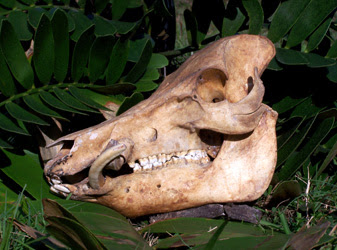
Editors Note: This occurred several years ago. Unfortunately I have no pictures of this adventure. I do have the skull of the boar; it is one of my most treasured trophies. My attempts to reunite with Jim and Mike have been, unfortunately unsuccessful…)
It was bound to happen sooner or later...
When you hunt as I like to, at close quarters, purposely putting your life in danger, you are assured to have a hair graying, shave a few years off your life, bladder weakening experience.
Like many of my adventures, it had started, innocently enough, with a half-breed Russian boar that was given to me by, a good ol' boy who was cousin, to the sister of the wife, of the guy who fixes my friend Big Duke's car. At least that's how I understood it.
Big Duke is a free association type of guy, with an endless stream-of consciousness conversation that anesthetizes you as it washes over you. Somewhere, out of
that particular current
that morning, I picked up "mean old hog" and "cutters the size of butcher's knives". My interest piqued, I listen more intently but he had gone on to the "Butcher of Seville" which must had been a sequel to the "Barber of Seville", which, I am glad to say, I must have missed when it came through town. Interrupting and dragging him back to the hog part of the conversation, I found out that someone, somewhere wanted to get rid of a particularly nasty boar hog that they had somehow acquired.
Since I had four feral sows in my breeding pool, and a closely related boar, I seized on the opportunity to add new genetics to my breeding stock. Ol' Duke called his mechanic on his "top o da line" "cell-you-lar” phone, who then referred him to a party unknown to Duke or I. Not that it matters to Duke you understand. He is friends to all manner of stranger, whether tramp, vagabond or otherwise. Only person he doesn't like is a woman down the road that accused him of horse thievery. Actually it was pony thievery that was leveled at him but Duke took it as the insult that it was. That pony had wandered off more times than there are stars in the sky; it was 36 years old and as senile as a demented armadillo. One night it wandered off; Duke and I managed to track it into the "Mexican Quarter" as we call it, but lost it on the asphalt, and it hasn't been seen since then. I do remember there being a big Fiesta the following day though...
Anyway, Duke hangs up the phone turns to me and says, "You want to fetch that Boar?"
Do hogs root? Of course I did.
We hitched up a horse trailer and went to rescue the poor animal so that he might serve a higher purpose as a stud at my hacienda the "Three Bar Spear".
When we arrived, I was not disappointed. Gordy, as he is known, has the quintessential "Razorback" look. Big headed, wide shouldered, a small rear end, and tusks fit to rip the hide off of an unsuspecting or foolish foe. His eyes were soulful pools of brown with lashes that most girls would kill for! After he was loaded up, which wasn't too difficult as he was pretty tame, I asked the fellows there how they came upon him. As it turned out these boys were avid hog trappers and hunters. We discussed different methods and techniques and I guess they took a liking to me because I was invited to join them on an afternoon hunt they had planned. I eagerly accepted and hustled Duke on out of there so I could get ready.
After an uneventful unloading, I bid Big Duke farewell, and headed in to get ready for the hunt. On this kind of hunt, with an unknown group, in an unknown area, I tend to either choose my slug gun or the Ruger sixgun in 45LC. I like the slug gun because of its authoritative slug; with a 776 grains hunk of lead, one shot, well placed of course, is all it ever takes. Now the sixgun's power is not to be dismissed lightly, the quick follow up shots are handy in addition to its inherent portability. A 335grain LBT type bullet from
Cast Performance backed by a caseful of Hodgdon’s H110 powder is serious medicine. Deciding on the Ruger I gave the cylinder and bore a quick spray of Brakleen to de-oil them and ran a clean patch through it all. I grabbed an even dozen of my custom hand loaded cartridges and put them in the carry case I use for travel.
I met up with Jimmy and Mike about an hour later at their home. “The dogs are loaded and ready to go.” said Jimmy as he hopped into his jacked up Ford. Mike was already in his, the dog boxes clean, shiny, and obviously loaded by the whines and occasional bark. It would be ironic later on, as I heard AC/DC’s Highway to Hell wafted in the summer breeze.
After a short ride we came to a ranch once owned by Jim’s uncle. My understanding was that the

gentleman was a world traveler, and brought home all sorts of exotic and interesting things. Unfortunately he had passed away some time ago and I was unable to meet him. I’m sure that he had some fascinating stories to tell.
I grabbed my South African made rig, loaded and holstered the sixgun, and put the extra rounds in my pocket.
The area we were hunting was a mixed palmetto scrub-land adjacent to a swampy area filled with cypress and fern. Patchy areas of the palmetto had recently burned affording us slightly better visibility than the norm. Mike opened up his dog boxes and out poured a pack of long legged hounds of indeterminate parentage and questionable pedigree. I know better than to question a man’s dog, but these guys looked like mongrels from the same litter. But I was soon to learn that these country boys knew more about dog breeding than anyone I have ever met. In a moment he had the six of them on two separate leads.

When Jim opened up the boxes on his truck, I almost backed up out of fear. The first dog slowly stretched out and gracefully stepped out of the box. A massive white head swiveled surveying the terrain and everything on it. She took a dainty leap and landed at my feet as nimble as a terrier. That is if a terrier weighed 90 or so pounds! The other one wasted no time and leaped down as if nothing could or would stop him. These dogs had mastiff sized heads with jaws that looked like they could tear a meaningful sized chunk off of a Volkswagen. Their legs were long but muscular, and they had bodies like Labs, thick and deep chested. If you asked me they were Great Dane, Mastiff,
Labrador crosses. Or Irish Wolfhound and Mastiff mixes. A giant boxer on steroids. Or something equally frightening! Their names were Roxy and Bull. Jimmy called them and they obediently sat down in front of him. Out of a box he pulled out wide, thick leather collars and buckled them on the dogs. Then he pulled out what turned out to be custom body armor for the dogs.
Wait a minute… Do the hogs here shoot back or something?” I asked, wondering if I had gotten into something I wasn’t prepared, ready, or armed for. “Nah…” Jimmy drawled. “This is to keep the hogs from cuttin’ up my babies.”
Babies!?!? The damned dogs looked like they ate babies! For all I knew they were Cerebus’ cousins.
“Do me a favor. Hold on to Roxy will ya?”
Sure.” I replied, still a little intimidated. Hell, I can think of a half dozen things I would rather be doing, like running sunburned and naked through a cactus patch. Anyway it turned out that she was as well mannered as any dog I have ever met and both the dogs were actually pretty friendly. Though, I will admit, at first sight they were absolutely menacing in appearance.
By the time the catch dogs were geared up, Mike had walked off with the hounds and was casting about to see if there was any scent to pick up. His main leather leads were about 12 feet long, each one with an additional three shorter lengths of leather thongs that the dogs were attached to. The dogs worked back and forth at an angle to him. Before long, one of the dogs gave an eager yelp; the other dogs converged upon him noses to the ground. One dog raised his head and let loose a howl that I swear sounded like a call to battle. At once the others joined in. Jim had his dogs on a much shorter lead and hurried to Mike. I followed closely; I was excited and though I didn’t know what was going on exactly, I knew it was about to start. Jim handed the lead to the two monsters to me.
Mike unclipped two of the dogs. They cast around, and when they decided which way to go they just started barking and took off. By then Mike and Jim had loosed the other four hounds and released them. Jim turned and said, “Those first two have the best nose. The rest are good, but those two are better!” Mike put his leads in his day pack and took Roxy and Bull from me.
Mike, who really doesn’t say much, asked, “What are y’all waiting for?” Jim smiled and asked me, “Ready?” “Hell yeah I’m ready!” I replied. To which he responded, “Well let’s go then!” and took off at a ground eating jog, following the baying dogs. I took off right behind him and Mike followed at a more leisurely pace.
Jim got ahead of me pretty quick. These fellows do nothing but work hard and move fast all day long, whereas I mostly sit on my fat rear end. All right, maybe I don’t really sit on my ass all the time, but I sure don’t work as hard as these fellows do. So I did my best to keep up.
Sometimes I’m a little slow witted, but I would have sworn I was catching up to them. If only I had known.
It wasn’t much longer when I realized I wasn’t getting closer to them, rather they were getting closer to me, and fast. I slowed down and tried to figure out which way exactly they were heading. Turning more towards the sun, I tried to intercept them. I stepped into a small swampy clearing and moments later the Big Ol’ Hog burst through the palmettos. He cast one baleful eye on me and slammed on the brakes. I was a couple of steps in and just as startled as that pig was, but I was slapping for leather when the first of the dogs came barreling through the screen of fronds. Dogs or no dogs, I knew I was about to experience the affectionate ministrations of a not-so-friendly hog.
You see, a cape buffalo might look at you like you owe him money, according to Ruark, but a big hog looks at you like you're in the wrong 'hood dude. And he's willing to cut you into hash right quick with those whetted tusks should he take a disliking to you. And as it so happened, yours truly, through no fault of his own, had antagonized this one enough to be considered the next subject of a slice and dice demo. The muzzle was clearing the holster as I started to step back.
I've heard it said that death was nature's way of telling you to slow down. Not being in the mood for slowing down just yet I took the path of least resistance and took a step back. A wait-a-minute vine leapt out, wrapped its evil thorned tentacles around my ankle and yanked me off my feet. Arms wind-milling wildly, I fell for what seemed an eternity.
At impact, the breath was knocked out of me. Now, with my eyes swimming, the pain in my ribs excruciating, I was in extremis; the cypress knee had caught me right on the short ribs and driven the air out of me. Groping for a handhold and gasping for breath I tried to scramble to a standing position. The dogs had slowed the pig down, and he had chosen to make another break for it, heading deeper into the swamp, so I wasn't in immediate danger, but I didn't know it. Dripping mud and finally on my feet, I looked around trying to get my bearings; at the same time Jimmy reached me and asked if I was OK. In between gasps I said I was all right, and added, “Lead on Ceasar! Lead on!”
You know,” he said, “most guys shoot at the pig as it takes off; they don’t usually lie down and nap during the action…” I shot him a look of pure evil. He laughed and slapped me one on the back and took off at a dead run to catch up with the hounds. Mike was still behind with the catch dogs. In the tumult I had managed to keep a grip on the Ruger and I took a moment to check it. Fortunately no mud had gotten into the barrel but it had been splashed pretty good. Wiping it off on my shirt I limped off after the guys.
Unable to ascertain Image Credit
The hounds were baying again and in no time I had caught up with the group where a savage fight was in full swing. The hounds had the hog surrounded. When he turned to slash one dog, the one on the opposite side would lunge and grab a mouthful of hair. Between the six of them they managed to keep the pig in one spot and avoid getting cut to ribbons. Finally Mike showed up with the catch dogs straining at the leashes; it was all he could do to hold them while Jimmy and I tried to simultaneously release them. Holding the collar of one I finally detached the lead. Jim did likewise and at his signal we let loose the dogs. The two wasted no time in closing the short distance and launched themselves at the boar. Occupied with the hounds that lunged and snapped at it, the boar didn't notice the big dogs until 180 combined pounds slammed into his side.
One dog locked it jaws on the flank while the other tried to grab it by the neck or ear. The boar didn’t get that big by being whusy, that’s for sure. In less than a blink of an eye, that hog twisted, caught the female in the shoulder, and flipped that animal head over heels ten feet. She landed heavily on her back and lay there momentarily stunned. Bull though, had gotten a mouthful of pig and wasn’t about to let go. The hounds were baying and adding to the general cacophony.
I had the Ruger in hand looking for a shot. Twice I raised it but had to put it down.
“Don’t hit the dogs!” Jimmy screamed.
There was no way I was getting a clear shot from any position. Any piece of that black hide that came into view was quickly covered by dog. And regardless, the LBTs I use would go through that hog like the proverbial hot knife through butter.
Roxy staggered to her feet and shook the blow off, the body armor having saved her from being split open like a bratwurst. She turned back to the brawl and hesitated only a moment before launching herself back into the battle. Bull still had the hog’s rear end and Roxy had aimed for the hogs opposite end.
I did the only thing I could think of.
I charged!
An unintelligible roar came unbidden from my throat. A half dozen strides and I was in the middle of the melee. A dog hit me hard in the leg almost knocking me over. I had flanked the hog, but anyone who has a hog can attest that they can switch ends in half a heartbeat - but not if he’s wearing a couple of dogs as jewelry. I stuck the muzzle somewhere on the top centerline of the hog and pulled the trigger. 325 grains of hardened lead slammed into the boar. I don’t know how, but I managed to thumb the hammer back and do it again, this time catching him at the base of the neck. Both slugs drove through the hog, lost in the soggy ground.
As the pig hit the ground, Roxy and Bull stretched him out, while the hounds all grabbed a piece of pigskin. The pig was good and truly dead. I was standing in the middle of it all, not quite sure if it was all over. Mike and Jim were on me slapping my back and laughing at my theatrics.
Mike was able to tether all of the hounds pretty quickly, but Roxy and Bull took quite a bit of cajoling before they would let go their hard won prize.
On the painful but rewarding walk back to the truck, I asked Jim what kind of dogs his catch dogs were. He told me that his uncle had brought four dogs from somewhere in South America sometime in the Sixties. They had bred them from those four, out crossing them to Bull-Mastiffs at some time past. Many in his family and some friends had them and they occasionally breed them as the need arises.
I went and researched this as I was truly curious as to what kind of dogs these might be. The closest I could come to was the Doggo Argentino. These were bred by Argentinean ranchers specifically to hunt imported European hogs and stag. The description fits these fellows almost exactly. I sure do wish I could have met Jimmy’s uncle, I bet he really had some incredible adventures and stories he could tell!
Mike’s pack was in fact a bunch of carefully bred curs. His father had started the pack several decades ago with some Bloodhounds, Walkers, and, believe it or not, an Afghan. They have bred them for nose, courage, and speed. They cull them pretty hard; they either got it or don’t.
I wish I could experience another dog hunt as exciting as this one was
Related Posts:
Hog Sticking Raj Style! Pt I
Hog Sticking Raj Style! Pt II
Hogs and Dogs!
Best Regards,
Albert A Rasch
Member:
Shindand Tent Club
Member:
Hunting Sportsmen of the United States HSUS (Let 'em sue me.)
The Hunt Continues...
 Though he spends most of his time writing and keeping the world safe for democracy, Albert was actually a student of biology. Really. But after a stint as a lab tech performing repetitious and mind-numbing processes that a trained capuchin monkey could do better, he never returned to the field. Rather he became a bartender. As he once said, "Hell, I was feeding mice all sorts of concoctions. At the club I did the same thing; except I got paid a lot better, and the rats where bigger." He has followed the science of QDM for many years, and fancies himself an aficionado. If you have any questions, or just want to get more information, reach him via TheRaschOutdoorChronicles(at)MSN(dot)com.