© 2010 Albert A Rasch and
The Rasch Outdoor Chronicles
$g&m f9bd 45kd q!?5.
Ok, I occasionally go to the Field & Streams blogs. I like posting there now and again and touching base with a lot of folks I don't normally communicate with.
The one thing that bugs the living daylights out of me is the amount of SPAM comments on the blog. I mean really, will nobody moderate them nightly?
Well I guess all the complaints finally got someone to do something. Of course it was overboard. So now whenever I try to post a link to something related, or my blog's link, it kicks me out, the SPAM filter will not allow the post to be published. What a PITA! Guys, you're a big corporation, that's what you get interns for. They physically go through the blogs and clean them up! Jeez...
Now to the meat and potatos.
Seems like some Idaho Sheriff is telling folks that It's OK to break the law and shoot wolves. He says he's not.
From this story in the Spokesman-Review:
A northern Idaho sheriff said he is not advocating the illegal shooting of federally protected wolves by offering a hunting rifle and a shovel as the prize in a raffle called “.308 SSS Wolf Pack Raffle” in a region where SSS commonly stands for “shoot, shovel and shut up.” Idaho County Sheriff Doug Giddings said the SSS in the raffle stands for “safety, security and survival.” “We knew that this would stir up some interest,” Giddings told the Lewiston Tribune.
Seriously.
I believe him like I believe in the tooth fairy.
And of course there was the usual diatribe against the Federal Government, the US Fish and Wildlife, the New World Order, and asorted and sundry other things. Almost sounded like a fringe element of the Tea Party had gathered in one place. One fellow tongue in cheek (maybe...) said we ought to let some wolves loose in Central Park, while another wondered why common birds in one place couldn't be shot at, after all there are a lot of them here! So I had to respond:
How many of you are wildlife biologists?
Just saying...
But this smacks of two things.... ok several.
1) Laws are laws. If we pick and choose which ones we will follow, then we are essentially lawless. I believe Socrates spoke at length on the subject as did Benjamin Franklin.
2) Sometimes, and I mean sometimes, we as a people need to see the bigger picture. That's were a Federal Gov't comes into play. Yes, the rancher in Idaho may not like wolves eating his livestock, but the wildlife manager sees a halt to CCD. So which is more important?
Releasing (hungry) wolves in Central Park, while amusing and certainly something I would enjoy, would not change the equation. Wild menacing wolves howling at night and striking fear into grown mens' hearts, eating poodles, cats, homeless people, and the occasional child does not constitute an issue over livelyhood. It's just a animal niusance issue. Still it would be entertaining.
The Spaniards use the Spanish Mastif to protect their flocks and herds. Very effective. But I doubt many American ranchers want to go through the trouble of following their herds around and penning them up nightly. All together too much trouble for the subsidized industry now isn't it. Much easier to minimize threats and leave it at that. It would be too expensive to spend his or her valuable time out there. What! You can't pass the cost to the consumer?
Now how much is that Dollar Whopper again? Should it really only be a dollar?
And one more thing, just because something is plentiful here, doesn't necessarily make it so way over there! If we as sportsmen, can't even be trusted to clean out the bilges of our boats to stop the spread of invasive species, how can you be trusted to decide what should or shouldn't be hunted? Seriously.
Now I would like to hear some common sense approaches to this.
Best Regards,
Albert A Rasch™
Member: Shindand Tent Club
Member: Hunting Sportsmen of the United States HSUS (Let 'em sue me.)
The Hunt Continues...
Wednesday, December 1, 2010
The Range Reviews: Recreating the 18th Century Powder Horn
© 2010 Albert A Rasch™ and
The Rasch Outdoor Chronicles
$g&m f9bd 45kd q!?5.
After watching me struggle, cuss, and hack my way through two powder horn projects, niether of which is really complete, and fill up my little corner of the living room with sawdust and horn detritus, my wife went and ordered Recreating the 18th Century Powder Horn by Scott and Cathy Sibley.
I am eagerly anticipating going home next year and reading my new gift! In the mean time, I have to ensconse myself at my desk here in Afghanistan, and be satisfied to look at scans my wife has been sending me.
I was immediately taken by the clear photos and detailed instructions that made it easy to understand what and how to do any number different steps in the creation of an art quality powder horn. And not just one type mind you, but several different types.
The authors, Scott and Cathy Sibley are well known powder horn makers and scrimshaw artists. I Googled them up and found a variety of references to their work, especially at Contemporary Makers. Contemporary Makers is a blog that covers the contemporary artists in period gun work, including accouterments; well worth the visit!
Scott is both a retired soldier, and a retired teacher. Cathy is retired school administrator. They got started making powder horns and quill-work while teaching school in the outer most reaches of Alaska.
I have been diligently working on a powderhorn for one of my friends, and I am very anxious to complete it on my next R&R. I have already picked up quite a few hints and new ideas from the excellent explanations in the book. The clear and well posed pictures make it easy to understand, and the Sibley's skill is obvious. The photography deseves a mention of its own; the quality and clarity is superb!

The book is divided into 21 chapters. It starts off in logical fashion with "Tools and Materials," followed by "Selecting a Horn." Thereafter it explains how you should set up your work area, (Believe me, nothing like mine!) and then starts from the begining in a logical and step by step horn making manner. The photography complements the descriptions very well, and options are presented for different time periods or styles
Just to be clear, I don't work in any recognized style, period, or era. Shoot, until I started reading about 17th and 18th century blackpowder stuff, I didn't even realize there were different eras! Now I know better...

The scrimshawing section of the book is very well illustrated and explained. My next attempt at scratching away on a powder horn should be more successful than not! Selecting the proper tools for your project and clear, step-by-step directions are given. Something I appreciated was the scrimshaw patterns at the back of the book. It gives you some idea of where you might want to go with your scrimshaw.

The last two chapters have examples of original horns, followed by horns made by Contemporary Makers. It is an excellent reference to guide you to those styles and eras I mentioned earlier!

I have found powder horn making to be a rewarding combination of crafts. Not only are you working with horn, but you will pick out and work with wood, and possibly do some metal shaping should the mood strike you, to complete your horn.There are techniques discussed for using dyes or stains, many types of carving are covered, along with filing and shaping tools. The end result of the mess you are going to make, is a beautiful powder horn for your collection that will merit both artistic and practical praise.
For those of you looking for an entertaining and productive pasttime, maybe an activity to take your mind off of something, working with your hands to make a powder horn will be very rewarding. You will find Recreating the 18th Century Powder Horn is an incredible reference for the budding horn maker. I would recommend it without reservation!
Recreating the 18th Century Powder Horn
Softcover, $19.95
91 pages, 11" x 8-1/2"
ISBN 0-9765797-0-7
Best Regards,
Albert A Rasch™
Member: Shindand Tent Club
Member: Hunting Sportsmen of the United States HSUS (Let 'em sue me.)
The Hunt Continues...
Though he spends most of his time writing and keeping the world safe for democracy, Albert was actually a student of biology. Really. But after a stint as a lab tech performing repetitious and mind-numbing processes that a trained capuchin monkey could do better, he never returned to the field. Rather he became a bartender. As he once said, "Hell, I was feeding mice all sorts of concoctions. At the club I did the same thing; except I got paid a lot better, and the rats where bigger." He has followed the science of QDM for many years, and fancies himself an aficionado. If you have any questions, or just want to get more information, reach him via TheRaschOutdoorChronicles(at)MSN(dot)com.
The Rasch Outdoor Chronicles
$g&m f9bd 45kd q!?5.
The Range Reviews
After watching me struggle, cuss, and hack my way through two powder horn projects, niether of which is really complete, and fill up my little corner of the living room with sawdust and horn detritus, my wife went and ordered Recreating the 18th Century Powder Horn by Scott and Cathy Sibley.
I am eagerly anticipating going home next year and reading my new gift! In the mean time, I have to ensconse myself at my desk here in Afghanistan, and be satisfied to look at scans my wife has been sending me.
I was immediately taken by the clear photos and detailed instructions that made it easy to understand what and how to do any number different steps in the creation of an art quality powder horn. And not just one type mind you, but several different types.
The authors, Scott and Cathy Sibley are well known powder horn makers and scrimshaw artists. I Googled them up and found a variety of references to their work, especially at Contemporary Makers. Contemporary Makers is a blog that covers the contemporary artists in period gun work, including accouterments; well worth the visit!
Scott is both a retired soldier, and a retired teacher. Cathy is retired school administrator. They got started making powder horns and quill-work while teaching school in the outer most reaches of Alaska.
I have been diligently working on a powderhorn for one of my friends, and I am very anxious to complete it on my next R&R. I have already picked up quite a few hints and new ideas from the excellent explanations in the book. The clear and well posed pictures make it easy to understand, and the Sibley's skill is obvious. The photography deseves a mention of its own; the quality and clarity is superb!
The book is divided into 21 chapters. It starts off in logical fashion with "Tools and Materials," followed by "Selecting a Horn." Thereafter it explains how you should set up your work area, (Believe me, nothing like mine!) and then starts from the begining in a logical and step by step horn making manner. The photography complements the descriptions very well, and options are presented for different time periods or styles
Just to be clear, I don't work in any recognized style, period, or era. Shoot, until I started reading about 17th and 18th century blackpowder stuff, I didn't even realize there were different eras! Now I know better...
The scrimshawing section of the book is very well illustrated and explained. My next attempt at scratching away on a powder horn should be more successful than not! Selecting the proper tools for your project and clear, step-by-step directions are given. Something I appreciated was the scrimshaw patterns at the back of the book. It gives you some idea of where you might want to go with your scrimshaw.
The last two chapters have examples of original horns, followed by horns made by Contemporary Makers. It is an excellent reference to guide you to those styles and eras I mentioned earlier!
I have found powder horn making to be a rewarding combination of crafts. Not only are you working with horn, but you will pick out and work with wood, and possibly do some metal shaping should the mood strike you, to complete your horn.There are techniques discussed for using dyes or stains, many types of carving are covered, along with filing and shaping tools. The end result of the mess you are going to make, is a beautiful powder horn for your collection that will merit both artistic and practical praise.
For those of you looking for an entertaining and productive pasttime, maybe an activity to take your mind off of something, working with your hands to make a powder horn will be very rewarding. You will find Recreating the 18th Century Powder Horn is an incredible reference for the budding horn maker. I would recommend it without reservation!
Recreating the 18th Century Powder Horn
Softcover, $19.95
91 pages, 11" x 8-1/2"
ISBN 0-9765797-0-7
Best Regards,
Albert A Rasch™
Member: Shindand Tent Club
Member: Hunting Sportsmen of the United States HSUS (Let 'em sue me.)
The Hunt Continues...
Though he spends most of his time writing and keeping the world safe for democracy, Albert was actually a student of biology. Really. But after a stint as a lab tech performing repetitious and mind-numbing processes that a trained capuchin monkey could do better, he never returned to the field. Rather he became a bartender. As he once said, "Hell, I was feeding mice all sorts of concoctions. At the club I did the same thing; except I got paid a lot better, and the rats where bigger." He has followed the science of QDM for many years, and fancies himself an aficionado. If you have any questions, or just want to get more information, reach him via TheRaschOutdoorChronicles(at)MSN(dot)com.
Monday, November 29, 2010
Hunting Shows: If They Suck, Why are They On?
© 2010 Albert A Rasch™ and
The Rasch Outdoor Chronicles
$g&m f9bd 45kd q!?5.
"Personally, I think the majority of hunting shows stink."
I started to write a post on the very subject some time ago, but it was such a diatribe against "Horn Porn", rich people buying trophies, and celebrities numbskulls, that I finally deleted it. As far as I could discern, there was niether artistic nor educational merit in any of the shows. I couldn't get past the gratuitous "Kill Shot," and the overbearing and abundant use of "Pseudo-Redneck" language employed by the majority of the participants.
Galen Geer of The Thinking Hunter, has put together a well thought out and researched post on the very subject questioning among other things, the ethics being taught by the medium.
"...frustrated by the constant butchery of verb tense and number by the “stars.” Her displeasure is nothing new from people who care about language. This is the foundation of most arguments against outdoor television, and a second argument is that the programs are unrealistic. To one degree or another, the claim can be made that we turn a blind eye to both problems and grudgingly admit that the problems are endemic to the medium and not going away."
Responsibility in Outdoor Media asks for some input from us, the outdoor blogging community. Does the Sportsman Channel, Vrs, ESPN, and other media outlets have some responsibility to the rest of society to portray ethical and appropriate behaviors?
Mr Geer would like to explore the following: "I am curious, however, what you think. For myself, I see an element of a growing problem with many new members of the outdoor media whose lack of a formal education in media law, ethics, practical journalism and creative writing/film/broadcasting, is contributing to increasing misinformation about hunting and fishing by many non-hunters/anglers."
Best Regards,
Albert A Rasch™
Member: Shindand Tent Club
Member: Hunting Sportsmen of the United States HSUS (Let 'em sue me.)
The Hunt Continues...
The Rasch Outdoor Chronicles
$g&m f9bd 45kd q!?5.
"Personally, I think the majority of hunting shows stink."
Albert A Rasch
I started to write a post on the very subject some time ago, but it was such a diatribe against "Horn Porn", rich people buying trophies, and celebrities numbskulls, that I finally deleted it. As far as I could discern, there was niether artistic nor educational merit in any of the shows. I couldn't get past the gratuitous "Kill Shot," and the overbearing and abundant use of "Pseudo-Redneck" language employed by the majority of the participants.
Galen Geer of The Thinking Hunter, has put together a well thought out and researched post on the very subject questioning among other things, the ethics being taught by the medium.
"...frustrated by the constant butchery of verb tense and number by the “stars.” Her displeasure is nothing new from people who care about language. This is the foundation of most arguments against outdoor television, and a second argument is that the programs are unrealistic. To one degree or another, the claim can be made that we turn a blind eye to both problems and grudgingly admit that the problems are endemic to the medium and not going away."
Responsibility in Outdoor Media asks for some input from us, the outdoor blogging community. Does the Sportsman Channel, Vrs, ESPN, and other media outlets have some responsibility to the rest of society to portray ethical and appropriate behaviors?
Mr Geer would like to explore the following: "I am curious, however, what you think. For myself, I see an element of a growing problem with many new members of the outdoor media whose lack of a formal education in media law, ethics, practical journalism and creative writing/film/broadcasting, is contributing to increasing misinformation about hunting and fishing by many non-hunters/anglers."
Best Regards,
Albert A Rasch™
Member: Shindand Tent Club
Member: Hunting Sportsmen of the United States HSUS (Let 'em sue me.)
The Hunt Continues...
Saturday, November 27, 2010
Saturday Blog Rodeo 11/27/10
© 2010 Albert A Rasch™ and
The Rasch Outdoor Chronicles
$g&m f9bd 45kd q!?5.
Well, I did it again, I got ahead of the game this week! Since it worked as well as it did last week, I figured I might as well do it again! Once again, as is my habit, I've roamed the ephemeral nether regions of the hunting and outdoorsmen's internet. And as you might imagine, I've picked out posts that I especially enjoyed this past week from all of blogs I follow, and some that I found. This week I am highlighting the craftsmen I try to emulate, but fail at miserably!
(Remember if you bump into a post you especially like, drop me a note and I'll include it in the Rodeo. You can even feel free to copy this whole post and run it on your own blog; it spreads the word, and it's always nice to give a little link love to your fellow bloggers!)
I might add that not a single one of you has ever taken me up on that offer!
Let's see if we might change that this week eh?
So without further adieu, lets get started!
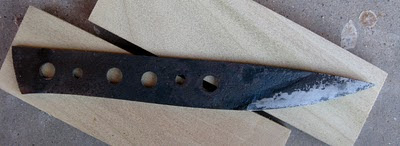
First up is Wonderful Whittlin'. John G is an accomplished wood carver. I first bumped into John's blog while I was looking at walking sticks. Why was I looking at walking sticks? I don't know, I just was! He had just finished his woodspirit walking stick project and I thought it wonderful. I have always liked carved walking sticks and staffs, and one of these days I may commision one. All of my walking sticks are basically sanded and oiled branches I have picked up in my wandering about. I have an umbrella stand full of them at home by the entry. John's work though, takes it to another level with his fanciful and playful designs! By the way, take a look at that handsome carving knife in the picture.
Next up is my old friend Todd at Primitive Point. As I am sure you all are tired of hearing, Todd actually got me started blogging. At the time I didn't know the medium existed, but through a discussion in a forum he and I frequented, he introduced me to the concept. He's a school teacher during the day, but in his spare time he is a bladesmith. Two things come to my mind when Todd hammers out a workingman's blade at his forge: practical and rugged. His forte is Scandi styled knives and integrals. I think enough of his skill and ability to ask him to consider forging a back-up knife for me. Nuff said.
Nehawka Priitive Skills is another favorite of mine. I really appreciate the effort and skill that many of the Paleo craftsmen have gained and exhibit. Mark, to be simplistic about it, takes rocks, sticks, and bones and turns them into fully functional tools and.... works of art! There's no other way to describe it. Some of his creations are not only lethal, but beautiful in form. I noticed that he hasn't posted in quite some time, so I've sent him an email to see what's up!
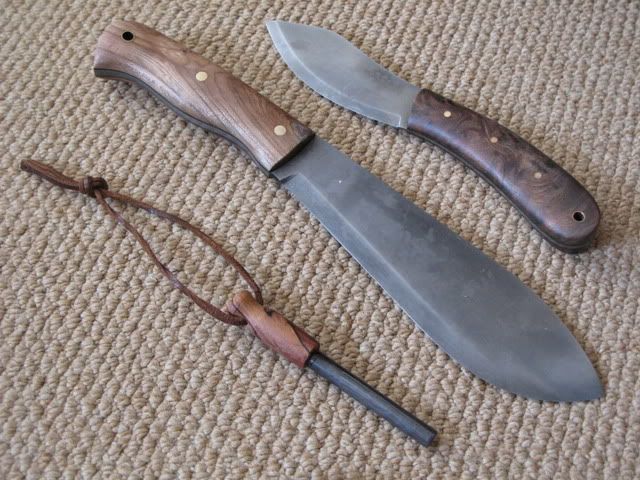
A Woodsman's Wanderings & Rambleings is new to me, and I found it through Primitive Point. Joel is a wood carver and bladesmith who makes all of his own working knives. He has several excellent articles and tutorials. To the right you will see an awesome set that Joel was commisioned to put together. That littke package there is pretty close to an ultimate outdoorsman's set. I think it's the cat's pajamas. The heavier bush knife is great for those things that require a little heft, while the skinner can handle all the other lighter tasks. Beautifuly executed!
I have several more that I would like to share with you all, but I have (as usual) run plum out of time again! As I write this it is 0401hours Saturday morning here in Herat province, the natives are restless, and I only have a few minutes to spend with you.
As we enter the holiday seasons, please be safe and secure.
Be alert; keep your eyes open and pay attention!
Complacency will get you hurt, or worse!
We can't be everywhere all of the time; you must take responsibility for your own safety!
Be especially vigilant when you are in crowded, popular places!
Do not be afraid. Be smart, be vigilant!
Best Regards,
Albert A Rasch™
Member: Shindand Tent Club
Member: Hunting Sportsmen of the United States HSUS (Let 'em sue me.)
The Hunt Continues...
Though he spends most of his time writing and keeping the world safe for democracy, Albert was actually a student of biology. Really. But after a stint as a lab tech performing repetitious and mind-numbing processes that a trained capuchin monkey could do better, he never returned to the field. Rather he became a bartender. As he once said, "Hell, I was feeding mice all sorts of concoctions. At the club I did the same thing; except I got paid a lot better, and the rats where bigger." He has followed the science of QDM for many years, and fancies himself an aficionado. If you have any questions, or just want to get more information, reach him via TheRaschOutdoorChronicles(at)MSN(dot)com.
The Rasch Outdoor Chronicles
$g&m f9bd 45kd q!?5.
Special Craftsman's Edition!
Saturday Blog Rodeo 11/27/10
Well, I did it again, I got ahead of the game this week! Since it worked as well as it did last week, I figured I might as well do it again! Once again, as is my habit, I've roamed the ephemeral nether regions of the hunting and outdoorsmen's internet. And as you might imagine, I've picked out posts that I especially enjoyed this past week from all of blogs I follow, and some that I found. This week I am highlighting the craftsmen I try to emulate, but fail at miserably!
(Remember if you bump into a post you especially like, drop me a note and I'll include it in the Rodeo. You can even feel free to copy this whole post and run it on your own blog; it spreads the word, and it's always nice to give a little link love to your fellow bloggers!)
I might add that not a single one of you has ever taken me up on that offer!
Let's see if we might change that this week eh?
So without further adieu, lets get started!
First up is Wonderful Whittlin'. John G is an accomplished wood carver. I first bumped into John's blog while I was looking at walking sticks. Why was I looking at walking sticks? I don't know, I just was! He had just finished his woodspirit walking stick project and I thought it wonderful. I have always liked carved walking sticks and staffs, and one of these days I may commision one. All of my walking sticks are basically sanded and oiled branches I have picked up in my wandering about. I have an umbrella stand full of them at home by the entry. John's work though, takes it to another level with his fanciful and playful designs! By the way, take a look at that handsome carving knife in the picture.
Next up is my old friend Todd at Primitive Point. As I am sure you all are tired of hearing, Todd actually got me started blogging. At the time I didn't know the medium existed, but through a discussion in a forum he and I frequented, he introduced me to the concept. He's a school teacher during the day, but in his spare time he is a bladesmith. Two things come to my mind when Todd hammers out a workingman's blade at his forge: practical and rugged. His forte is Scandi styled knives and integrals. I think enough of his skill and ability to ask him to consider forging a back-up knife for me. Nuff said.
Nehawka Priitive Skills is another favorite of mine. I really appreciate the effort and skill that many of the Paleo craftsmen have gained and exhibit. Mark, to be simplistic about it, takes rocks, sticks, and bones and turns them into fully functional tools and.... works of art! There's no other way to describe it. Some of his creations are not only lethal, but beautiful in form. I noticed that he hasn't posted in quite some time, so I've sent him an email to see what's up!
A Woodsman's Wanderings & Rambleings is new to me, and I found it through Primitive Point. Joel is a wood carver and bladesmith who makes all of his own working knives. He has several excellent articles and tutorials. To the right you will see an awesome set that Joel was commisioned to put together. That littke package there is pretty close to an ultimate outdoorsman's set. I think it's the cat's pajamas. The heavier bush knife is great for those things that require a little heft, while the skinner can handle all the other lighter tasks. Beautifuly executed!
I have several more that I would like to share with you all, but I have (as usual) run plum out of time again! As I write this it is 0401hours Saturday morning here in Herat province, the natives are restless, and I only have a few minutes to spend with you.
As we enter the holiday seasons, please be safe and secure.
Be alert; keep your eyes open and pay attention!
Complacency will get you hurt, or worse!
We can't be everywhere all of the time; you must take responsibility for your own safety!
Be especially vigilant when you are in crowded, popular places!
Do not be afraid. Be smart, be vigilant!
Best Regards,
Albert A Rasch™
Member: Shindand Tent Club
Member: Hunting Sportsmen of the United States HSUS (Let 'em sue me.)
The Hunt Continues...
Though he spends most of his time writing and keeping the world safe for democracy, Albert was actually a student of biology. Really. But after a stint as a lab tech performing repetitious and mind-numbing processes that a trained capuchin monkey could do better, he never returned to the field. Rather he became a bartender. As he once said, "Hell, I was feeding mice all sorts of concoctions. At the club I did the same thing; except I got paid a lot better, and the rats where bigger." He has followed the science of QDM for many years, and fancies himself an aficionado. If you have any questions, or just want to get more information, reach him via TheRaschOutdoorChronicles(at)MSN(dot)com.
Friday, November 26, 2010
Shooting or Hunting: An Ethical Question
© 2009, 2010 Albert A Rasch™ and
The Rasch Outdoor Chronicles
$g&m f9bd 45kd q!?5.

Last week we delved into the High Fence and Preserve Hunting question. Again I wanted to thank all of you for participating so enthusiastically and professionally. You do all sportsmen a great honor and service.
After carefully reading the post and comments, the impression is that the real question is about the ethics of shooting behind fences or enclosures. Is it ethical to shoot an animal in an enclosure and still call it hunting? Several comments were made questioning the ethics of doing so. But careful review of the conversation yielded no reasons for questioning the ethics of the activity. I might venture to say that it is reasonable to say that one man's ethics are another's moral morass.
At this point ethics and morals seem to be intertwined so tightly as to be indistinguishable. The easiest way to separate them is to define them. Morals are something that we all agree upon ie: killing for the sake of killing is wrong; broad general ideas. Whereas ethics are our method for assuring a moral outcome to any of our actions, or how we define our values. Those of you that are philosophy majors or philosophers please feel free to correct my definitions.
I propose that we dissect what transpires when we pull the trigger. At what point do we have to consciously make a decision as to whether the shot is righteous or not. Is there an ethical checklist that one must complete if and when he is to pull the trigger? Does it matter if you are feeding your family or killing for horns and antlers. What are the objective values that we need in order to make an ethical kill.
Much of it is subjective. Do you consciously decide if pulling the trigger will be ethical when it's a rat? Most will strive to humanely end the rodent' s life by shooting carefully and with purpose. Some would be satisfied with any thing that will end the creatures life now or later, as long a sit dies.
It becomes stickier when the competitive nature of the human race comes into play. You've paid $4500 for a three day guided Mule Deer hunt. You brought the wife along, and she's been fawning over the rugged, broad shouldered guide. You know that your comfort zone is inside of 125 yards. Your guide gets you to just inside of 270 yards on a broad racked 4X4. He puts down his laser range finder and tells you it is 270 yards. He says it's big and tells you to take the shot. He puts his 10X Stetson down for your rifle to rest on for God's sake.
What do you do?
That would be determined by your definition of right or wrong, your ethics.
Is it a 30/30 or 300 Winchester Magnum.
Your knowledge of the ballistics table.
Have you any experience at 300 yards
Can you whip the guide if you mess it up and he chortles about it up at the lodge.
In front of the other hunters... and your wife.
Well maybe that last one doesn't count, but I sure as hell would add it to my equation.
I don't care how big the deer is, if I had a Winchester 94 in thirty-thirty I wouldn't shoot. That's the extent of my decision making process on that particular scenario. I know what I'm capable of and I leave it at that. Whereas with my Weatherby 30/06 I might consider the shot determined by the particular scenario.
Now, if I am in an enclosed property, it would depend upon my perception of whether I earned that deer ; did I work for it. First thing, why am I there? In my particular case, it wouldn't be for a magnificent specimen of that species. No, I would either be shooting culls for meat, or hunting a representative example of the species.
If I was shooting for meat I wouldn't take the shot. I'm there for meat not a big deer. If I was there for antlers, I would take the shot assuming in this case that I had fulfilled my personal criteria for an acceptable hunting experience, and I was comfortable with the probability of that shot.
"A Trophy is a Trophy is a Trophy, and to each his own." Adds Mike Riddle of Native Hunt. "My Trophy might not make P&Y or B&C or S.C.I. books but, it will always remain "MY" Trophy each and every time I look upon it, and reflect on that particular hunt while reliving the most vivid of memories which are conjured up from that hunt."
My primary game species is the feral hog. Most of the time hogs are baited, but in my particular case, I ambush them on their way to the bait, that's what I prefer. I've also ridden in doorless vehicles, four wheelers, and on horseback in pursuit of them, and chased them with dogs. Many of these hunts are less than an hour long from start to finish, but they are hunting expeditions none the less. Personally I have never shot an animal from a vehicle moving vehicle. But I have dismounted and stalked into position to take a killing shot.
Traditions also play an important factor in what we consider ethical. In the south, you chase deer with dogs. When I moved here I was aghast! Up north you shoot dogs that chase deer! But after consideration of the effect, the traditions, and the sport, I concluded that it was just another method of hunting. Interestingly enough I consider hunting hog, bear, or lions with hounds the height of hunting. Well, the height would be wild boar, hounds, horses and lances, but you get what I mean.
In some areas up north you can bait bear. That is an acceptable means of hunting for those areas. If the management goals of that area were negatively impacted by the practice then it is well within the scope of scientists in the management division to curtail the practice. It is not acceptable for others to deny the practice because they feel it is unethical.
The Hodgeman, as always, does a great job of illustrating the discussion:
"When we step outside of our culture and examine hunting traditions of other cultures the ideas get more outside our realm of experience. When I first moved to Alaska and saw some of the hunting practices in Western AK I was appalled. Shooting swimming caribou from boats, baiting bears, setnets, killing whales- among other things. It took me a while to realize this was a trip to the "store" and the people involved didn't want the experience to be "sporting" because it was their method of survival. Is it ethical- certainly. Moral- I think so. Is it for me- no."
"What passes as ethical for a resident of the Y-K delta who's surviving from nature suddenly becomes unethical if I do it- because its not ethical in the culture I exist in."
"Common practices in my culture- catch and release fishing, shooting large bulls not fit for consumption, even fair chase are looked at as disrespectful of nature from a subsistence perspective."
Hodge, thanks for helping refine the discussion.
Though I have absolutely no interest in ever (Well, the opportunity hasn't come up...) harpooning a whale, I appreciate the skill and the Inuit hunter's natural acumen when pursuing them. I also respect the scientists who determine what numbers may be taken, as long as it's science and not politics determining the numbers.
If we were to carefully analyze most situations that we commonly come into contention, we would find that in the end it is not you or I that can honestly say whether the action or activity is "hunting." Only the person in that moment, in that experience, can truly decide whether it is or isn't hunting.
My good friend and Black Powder enthusiast Rick Kratzke (Whitetail Woods ) has given some thought to how he defines his ethics.
"Ethics is a tricky word, but what I will tell you from my experience is this:
Now I know everyone has there own definition of what ethics means to them, but in the end if you hunt legally and harvest humanely, (the least amount of suffering to the animal), then you have done right."
An excellent synopsis of one person's ethical criteria for squeezing the trigger.
If you don't desire to participate in a particular form of hunting, or if you disapprove of a certain practice, then you are well within your rights to discuss it with others. But to discredit it or make claims that you cannot substantiate, that is wrong. We have enough opponents without making more of them within our own ranks.
I want to close with this, an observation from Holly Heyser, our own NorcalCazadora.
"If you let people argue about methods of killing (beyond the essential mandate of avoid cruelty/excessive suffering), they forget the simple fact that 96.8 percent of American adults eat things that used to have beating hearts. Wrap yourself in complicated ethical schemes and it becomes easier to marginalize some hunters; define hunting as one method in a larger system in which humans eat animals, and suddenly you can't separate us from the non-hunters - the only remaining divide is vegetarian v. meat eater, and we WAY outnumber the vegetarians."
Among the many things that we need:
Best Regards,
Albert A Rasch™
Member: Shindand Tent Club
Member: Hunting Sportsmen of the United States HSUS (Let 'em sue me.)
The Hunt Continues...
Though he spends most of his time writing and keeping the world safe for democracy, Albert was actually a student of biology. Really. But after a stint as a lab tech performing repetitious and mind-numbing processes that a trained capuchin monkey could do better, he never returned to the field. Rather he became a bartender. As he once said, "Hell, I was feeding mice all sorts of concoctions. At the club I did the same thing; except I got paid a lot better, and the rats where bigger." He has followed the science of QDM for many years, and fancies himself an aficionado. If you have any questions, or just want to get more information, reach him via TheRaschOutdoorChronicles(at)MSN(dot)com.
The Rasch Outdoor Chronicles
$g&m f9bd 45kd q!?5.
Hello Everyone! Once again this is work in progress. We will continue to modify, add, and refine as the conversation continues. You will notice that I have added permanent links somewhere over there to the right.
Albert
Last week we delved into the High Fence and Preserve Hunting question. Again I wanted to thank all of you for participating so enthusiastically and professionally. You do all sportsmen a great honor and service.
After carefully reading the post and comments, the impression is that the real question is about the ethics of shooting behind fences or enclosures. Is it ethical to shoot an animal in an enclosure and still call it hunting? Several comments were made questioning the ethics of doing so. But careful review of the conversation yielded no reasons for questioning the ethics of the activity. I might venture to say that it is reasonable to say that one man's ethics are another's moral morass.
At this point ethics and morals seem to be intertwined so tightly as to be indistinguishable. The easiest way to separate them is to define them. Morals are something that we all agree upon ie: killing for the sake of killing is wrong; broad general ideas. Whereas ethics are our method for assuring a moral outcome to any of our actions, or how we define our values. Those of you that are philosophy majors or philosophers please feel free to correct my definitions.
I propose that we dissect what transpires when we pull the trigger. At what point do we have to consciously make a decision as to whether the shot is righteous or not. Is there an ethical checklist that one must complete if and when he is to pull the trigger? Does it matter if you are feeding your family or killing for horns and antlers. What are the objective values that we need in order to make an ethical kill.
Much of it is subjective. Do you consciously decide if pulling the trigger will be ethical when it's a rat? Most will strive to humanely end the rodent' s life by shooting carefully and with purpose. Some would be satisfied with any thing that will end the creatures life now or later, as long a sit dies.
It becomes stickier when the competitive nature of the human race comes into play. You've paid $4500 for a three day guided Mule Deer hunt. You brought the wife along, and she's been fawning over the rugged, broad shouldered guide. You know that your comfort zone is inside of 125 yards. Your guide gets you to just inside of 270 yards on a broad racked 4X4. He puts down his laser range finder and tells you it is 270 yards. He says it's big and tells you to take the shot. He puts his 10X Stetson down for your rifle to rest on for God's sake.
What do you do?
That would be determined by your definition of right or wrong, your ethics.
Is it a 30/30 or 300 Winchester Magnum.
Your knowledge of the ballistics table.
Have you any experience at 300 yards
Can you whip the guide if you mess it up and he chortles about it up at the lodge.
In front of the other hunters... and your wife.
Well maybe that last one doesn't count, but I sure as hell would add it to my equation.
I don't care how big the deer is, if I had a Winchester 94 in thirty-thirty I wouldn't shoot. That's the extent of my decision making process on that particular scenario. I know what I'm capable of and I leave it at that. Whereas with my Weatherby 30/06 I might consider the shot determined by the particular scenario.
Now, if I am in an enclosed property, it would depend upon my perception of whether I earned that deer ; did I work for it. First thing, why am I there? In my particular case, it wouldn't be for a magnificent specimen of that species. No, I would either be shooting culls for meat, or hunting a representative example of the species.
If I was shooting for meat I wouldn't take the shot. I'm there for meat not a big deer. If I was there for antlers, I would take the shot assuming in this case that I had fulfilled my personal criteria for an acceptable hunting experience, and I was comfortable with the probability of that shot.
"A Trophy is a Trophy is a Trophy, and to each his own." Adds Mike Riddle of Native Hunt. "My Trophy might not make P&Y or B&C or S.C.I. books but, it will always remain "MY" Trophy each and every time I look upon it, and reflect on that particular hunt while reliving the most vivid of memories which are conjured up from that hunt."
My primary game species is the feral hog. Most of the time hogs are baited, but in my particular case, I ambush them on their way to the bait, that's what I prefer. I've also ridden in doorless vehicles, four wheelers, and on horseback in pursuit of them, and chased them with dogs. Many of these hunts are less than an hour long from start to finish, but they are hunting expeditions none the less. Personally I have never shot an animal from a vehicle moving vehicle. But I have dismounted and stalked into position to take a killing shot.
Traditions also play an important factor in what we consider ethical. In the south, you chase deer with dogs. When I moved here I was aghast! Up north you shoot dogs that chase deer! But after consideration of the effect, the traditions, and the sport, I concluded that it was just another method of hunting. Interestingly enough I consider hunting hog, bear, or lions with hounds the height of hunting. Well, the height would be wild boar, hounds, horses and lances, but you get what I mean.
In some areas up north you can bait bear. That is an acceptable means of hunting for those areas. If the management goals of that area were negatively impacted by the practice then it is well within the scope of scientists in the management division to curtail the practice. It is not acceptable for others to deny the practice because they feel it is unethical.
The Hodgeman, as always, does a great job of illustrating the discussion:
"When we step outside of our culture and examine hunting traditions of other cultures the ideas get more outside our realm of experience. When I first moved to Alaska and saw some of the hunting practices in Western AK I was appalled. Shooting swimming caribou from boats, baiting bears, setnets, killing whales- among other things. It took me a while to realize this was a trip to the "store" and the people involved didn't want the experience to be "sporting" because it was their method of survival. Is it ethical- certainly. Moral- I think so. Is it for me- no."
"What passes as ethical for a resident of the Y-K delta who's surviving from nature suddenly becomes unethical if I do it- because its not ethical in the culture I exist in."
"Common practices in my culture- catch and release fishing, shooting large bulls not fit for consumption, even fair chase are looked at as disrespectful of nature from a subsistence perspective."
Hodge, thanks for helping refine the discussion.
Though I have absolutely no interest in ever (Well, the opportunity hasn't come up...) harpooning a whale, I appreciate the skill and the Inuit hunter's natural acumen when pursuing them. I also respect the scientists who determine what numbers may be taken, as long as it's science and not politics determining the numbers.
If we were to carefully analyze most situations that we commonly come into contention, we would find that in the end it is not you or I that can honestly say whether the action or activity is "hunting." Only the person in that moment, in that experience, can truly decide whether it is or isn't hunting.
My good friend and Black Powder enthusiast Rick Kratzke (Whitetail Woods ) has given some thought to how he defines his ethics.
"Ethics is a tricky word, but what I will tell you from my experience is this:
- I don't shoot unless I feel I can make the shot.
- I take pride in following the laws and regulations set forth by the state I live in.
- I don't harvest anything unless I intend to eat it
- I don't harvest anymore than I can consume in one year unless I am donating it to the homeless.
- I can honestly say I have passed up deer when I could have shot, but didn't, because it was not legal to do so.
Now I know everyone has there own definition of what ethics means to them, but in the end if you hunt legally and harvest humanely, (the least amount of suffering to the animal), then you have done right."
An excellent synopsis of one person's ethical criteria for squeezing the trigger.
If you don't desire to participate in a particular form of hunting, or if you disapprove of a certain practice, then you are well within your rights to discuss it with others. But to discredit it or make claims that you cannot substantiate, that is wrong. We have enough opponents without making more of them within our own ranks.
I want to close with this, an observation from Holly Heyser, our own NorcalCazadora.
"If you let people argue about methods of killing (beyond the essential mandate of avoid cruelty/excessive suffering), they forget the simple fact that 96.8 percent of American adults eat things that used to have beating hearts. Wrap yourself in complicated ethical schemes and it becomes easier to marginalize some hunters; define hunting as one method in a larger system in which humans eat animals, and suddenly you can't separate us from the non-hunters - the only remaining divide is vegetarian v. meat eater, and we WAY outnumber the vegetarians."
Among the many things that we need:
- Scholarly works that we should all be familiar with. Holly Heyser has a post on must read texts on hunting traditions and philosophies: "Books About Hunting ..."
- Solid science in layman's terms for all of us to be able to grasp easily and use in our own defense.
Again this is a work in progress. I'll be adding to it as the discussion builds. Thank you everyone for your participation an help!
Best Regards,
Albert A Rasch™
Member: Shindand Tent Club
Member: Hunting Sportsmen of the United States HSUS (Let 'em sue me.)
The Hunt Continues...
Though he spends most of his time writing and keeping the world safe for democracy, Albert was actually a student of biology. Really. But after a stint as a lab tech performing repetitious and mind-numbing processes that a trained capuchin monkey could do better, he never returned to the field. Rather he became a bartender. As he once said, "Hell, I was feeding mice all sorts of concoctions. At the club I did the same thing; except I got paid a lot better, and the rats where bigger." He has followed the science of QDM for many years, and fancies himself an aficionado. If you have any questions, or just want to get more information, reach him via TheRaschOutdoorChronicles(at)MSN(dot)com.
Subscribe to:
Posts (Atom)